
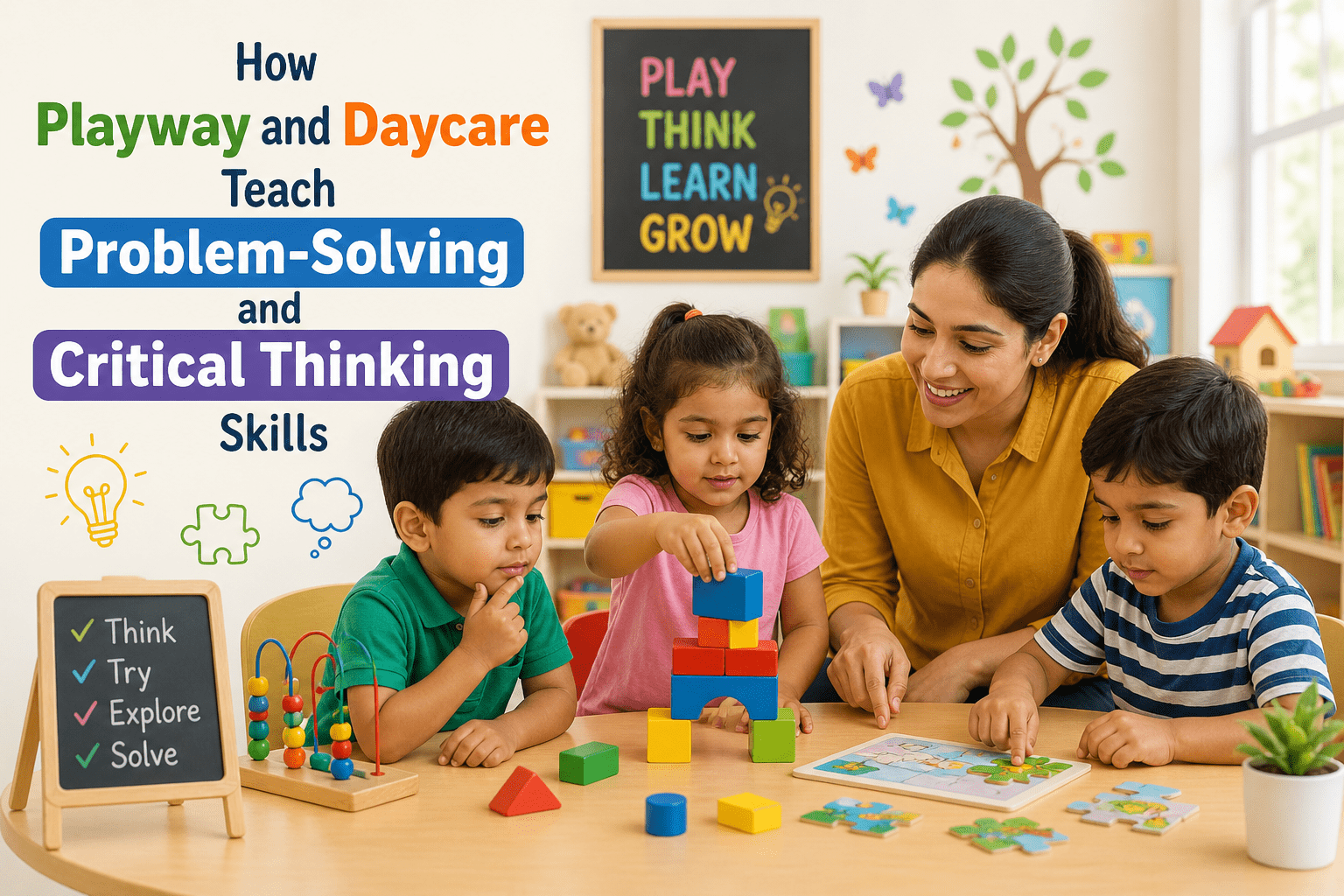
Early childhood is a critical time for learning. During these formative years, children develop important skills that shape their future. One of the most valuable skills children can learn at a young age is problem-solving skills and critical thinking skills. Playway and daycare programs offer a unique environment for children to build these tech problem solving skills in fun and engaging ways. In this article, we will explore how playway and daycare settings contribute to the development of problem solving skills and critical thinking skills in young children.
What is Problem Solving skills and Critical Thinking?
Before diving into how playway and daycare teach these problem solving skill and critical thinking skill, it’s important to understand what problem solving and critical thinking actually are.
- Problem solving skill refers to the ability to identify challenges or obstacles and come up with creative ways to overcome them. It’s about thinking through situations and finding solutions.
- Critical thinking skill is the ability to analyze information, ask questions, and make decisions based on reasoning and evidence. It involves evaluating different possibilities and considering the best course of action.
Both problem solving skills are vital for children’s growth and development, as they help them make decisions, navigate challenges, and interact with the world around them.
The Role of Playway and Daycare in Developing Problem-Solving Skills
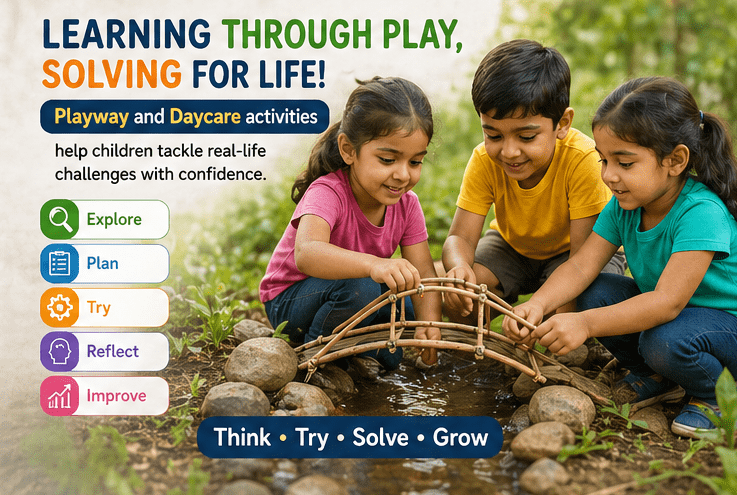
At playway and daycare centers, children are given many opportunities to practice problem-solving skills in everyday situations. Whether they are playing with toys, solving puzzles, or working in groups, they are constantly faced with challenges that require them to think critically. Here’s how daycare environments foster problem solving skills:
1. Engaging in Free Play
Free play is a cornerstone of play-based learning. During free play, children can choose their activities, which may involve building, drawing, or pretending. These activities often come with challenges that require creative thinking. For example, when children play with blocks, they might need to figure out how to stack them without them falling over. This kind of activity encourages children to test different solutions and see what works. This is one of the method of learn problem solving skills.
2. Learning Through Trial and Error
In playway and daycare settings, children are encouraged to try new things, even if they fail at first. Whether it’s trying to solve a puzzle, build a structure, or learn a new game, trial and error play a big role in problem solving skills. Children quickly learn that failure is part of the learning process, and they develop resilience and perseverance. This is one of the method of learn problem solving skills.
3. Collaborating with Peers
Problem solving skills often requires teamwork. In daycare, children are frequently asked to work together to solve problems, such as figuring out how to share toys, build a playhouse, or complete a group activity. Working with others allows children to hear different perspectives, brainstorm ideas, and learn how to compromise. Collaboration helps children realize that multiple solutions exist and that working together can lead to better outcomes. This is one of the method of learn problem solving skills.
4. Structured Challenges
While free play is crucial, structured challenges also play an important role in developing problem solving skills. Daycare teachers often set up activities like puzzles, memory games, or obstacle courses that require children to think critically. These structured activities guide children through specific tasks, helping them learn to break down problems into manageable steps. Over time, this builds their ability to approach more complex problems in the future. This is one of the method of learn problem solving skills.
The Role of Playway and Daycare in Developing Critical Thinking Skills
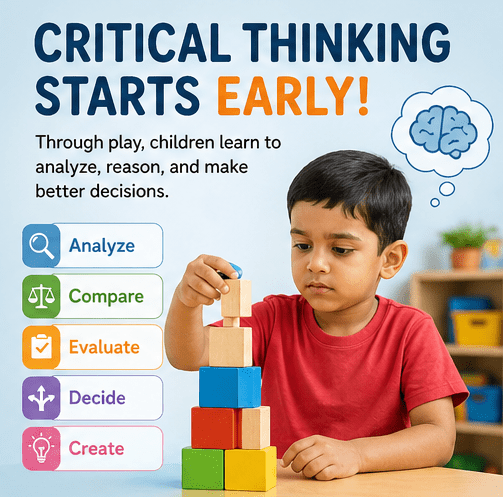
Critical thinking is equally important as problem solving skills, and daycare programs nurture this skill in several ways. Critical thinking involves questioning, analyzing, and reasoning, which all contribute to a child’s ability to make informed decisions. Here’s how daycare environments foster critical thinking:
1. Encouraging Exploration and Curiosity
Children are naturally curious, and playway and daycare settings allow them to explore their interests. Whether it’s exploring nature, trying out different materials in art class, or asking questions during storytime, daycare settings encourage children to ask “why” and “how.” These types of inquiries push children to think critically about the world around them. How it helps in critical thinking skills.
2. Asking Open-Ended Questions
Teachers in playway and daycare centers often ask open-ended questions to encourage critical thinking. For example, instead of asking a child, “What color is the ball?” a teacher might ask, “What do you think will happen if you roll the ball down the hill?” This kind of questioning encourages children to think beyond the obvious and explore different possibilities. It prompts them to make predictions, reason, and analyze outcomes. How it helps in critical thinking skills.
3. Introducing New Concepts Through Play
Introducing new concepts through play is a great way to spark critical thinking. Daycare teachers use toys, games, and activities to help children grasp abstract ideas. For instance, while playing a counting game, a child learns numbers, but they are also encouraged to think about quantity, order, and patterns. This helps children develop a deeper understanding of basic concepts and apply critical thinking when encountering new information. How it helps in critical thinking skills and problem solving skills.
4. Discussing Different Perspectives
Critical thinking involves understanding and considering multiple viewpoints. In daycare, children are often asked to think about how other children might feel or why someone may have acted a certain way. For example, when resolving conflicts, children are guided to consider both sides of a disagreement. This teaches them to evaluate situations from different angles, which is a key aspect of critical thinking.
The Connection Between Play and Cognitive Growth
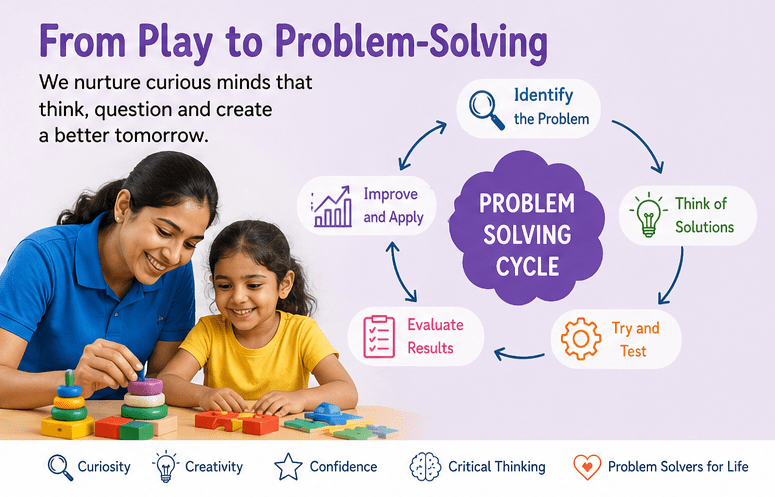
Play is an essential tool for cognitive development, and it plays a crucial role in teaching both problem solving skills and critical thinking. During play, children develop their ability to think abstractly, reason logically, and explore new ideas. Here’s how play and cognitive growth are connected:
- Building Cognitive Flexibility: Through play, children learn to switch between tasks, adapt to new rules, and find different ways to approach challenges. This flexibility is vital for problem solving skills and critical thinking.
- Enhancing Memory and Focus: Many games and activities in daycare require children to remember rules, patterns, or strategies. This strengthens their memory and helps them develop the ability to focus, both of which are key to solving problems and thinking critically.
- Stimulating Imagination: Imaginative play encourages children to think outside the box and consider different scenarios. It helps them develop creativity, which is often needed for effective problem solving skills.
Conclusion
In summary, playway and daycare settings provide rich environments for developing both problem solving skills and critical thinking skills. Through free play, structured activities, collaboration with peers, and the encouragement of curiosity, children learn to approach challenges with creativity and reasoned thinking. These skills not only help children succeed in school but also prepare them for life’s many challenges. As children engage in playful learning, they build a strong foundation for their cognitive development that will serve them well throughout their lives.
By providing opportunities for both problem solving skills and critical thinking, playway and daycare programs help young children grow into thoughtful, resilient, and innovative individuals. The skills they develop in these early years will shape their academic success and personal growth for years to come.
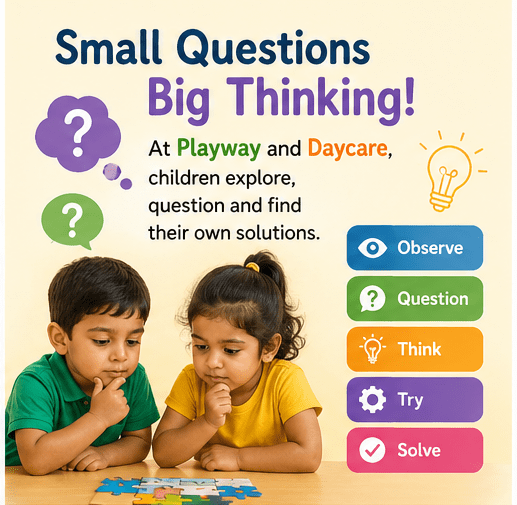
This article focuses on the vital role of playway and daycare programs in nurturing problem solving skills and critical thinking skills in young children. It uses simple language and clear examples to explain how these environments foster cognitive and social development.
To check our another blog
Get enroll